
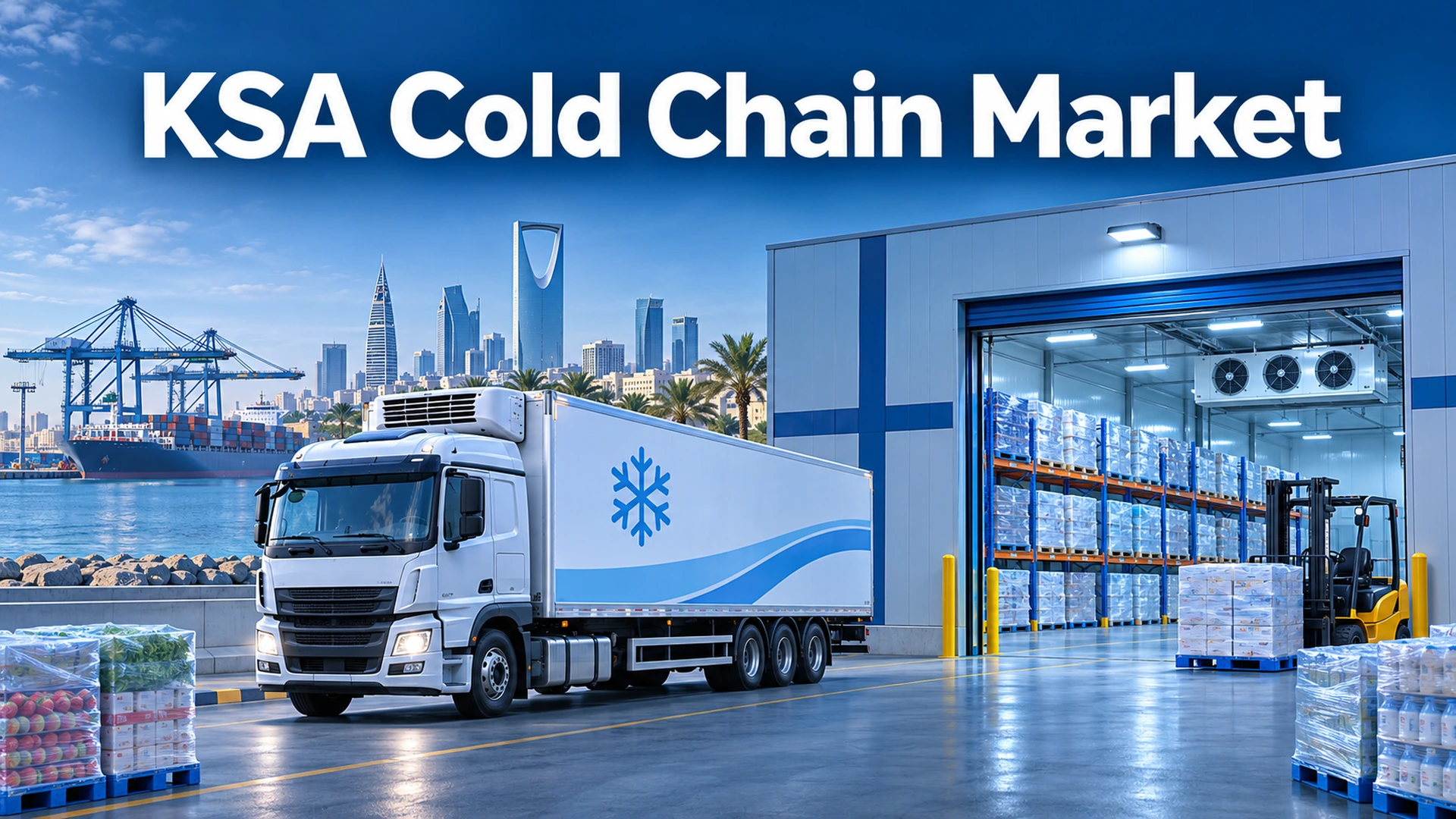
At a Glance
- Market size projected to reach USD 2.5 billion by 2027
- Compound annual growth rate of approximately 15% (15.1% reported) from 2022 to 2027
- Refrigerated vans dominate cold‑transport activity
- Riyadh, Jeddah and Dammam form the primary logistics clusters
- Key growth drivers: rising meat and dairy consumption, expanding seafood exports, higher retail spending, pharmaceutical imports and stricter food‑safety expectations
What Is Changing in the KSA Cold Chain Market?
The most pronounced shift is the rapid scaling of refrigerated‑van capacity, which now accounts for the majority of cold‑transport activity across Saudi Arabia. This expansion is directly tied to surging consumer demand for meat, dairy and seafood, as well as heightened expectations for pharmaceutical integrity. The KSA Cold Chain Market Outlook to 2027 shows that the market is moving from a nascent phase to a clearly growing stage, underpinned by Vision 2030’s logistics modernization agenda.
Beyond the surge in vehicle numbers, the market is witnessing a convergence of storage and transport functions. Operators are increasingly integrating cold‑storage facilities with their refrigerated fleets to create seamless temperature‑controlled pathways from producer to end‑user. This integrated approach is essential for maintaining product integrity, especially for high‑value pharmaceuticals and perishable food items that require strict temperature adherence throughout the journey.
Why Is Refrigerated‑Van Expansion Important for the KSA Cold Chain Market?
Impact on Market Demand
Refrigerated vans provide the flexibility needed to serve dispersed retail outlets and last‑mile delivery points, especially within the three logistics hubs of Riyadh, Jeddah and Dammam. As retail spending climbs and consumers seek fresher, higher‑quality perishable goods, the demand for temperature‑controlled transport intensifies. The report notes that meat consumption, dairy demand and seafood exports are primary consumption drivers, creating a direct pipeline of goods that must be moved quickly and kept at precise temperatures.
In parallel, the pharmaceutical sector is expanding its import volumes, adding a layer of complexity to demand patterns. Pharmaceuticals require not only temperature control but also rigorous documentation and traceability, prompting shippers to seek carriers that can guarantee both physical and data integrity. The combined pressure from food and pharma segments is stretching the capacity of existing fleets, thereby accelerating the need for additional refrigerated vans.
Impact on Competition
Key players such as Mosanda, Agility, Wared, NAQEL and Almajdouie compete on the breadth of their storage networks, fleet size, geographic coverage and technology‑enabled visibility. The dominance of refrigerated vans forces operators to differentiate through fleet reliability, temperature integrity and real‑time monitoring, raising the competitive bar across the sector.
Competition is also intensifying around service differentiation. Companies that can demonstrate lower temperature‑excursion rates, faster delivery windows, and integrated end‑to‑end visibility are gaining a strategic edge. This competitive pressure is prompting firms to invest in advanced telematics, predictive maintenance, and data‑analytics platforms that can pre‑empt disruptions before they affect the cold chain.
Impact on Market Growth
The 15% CAGR forecast reflects the cumulative effect of demand growth and the scaling of refrigerated‑van fleets. As more firms invest in modern warehousing and last‑mile refrigerated capacity, the overall market size is projected to reach USD 2.5 billion by 2027, confirming the sector’s robust growth trajectory.
Growth is further reinforced by Vision 2030’s emphasis on logistics infrastructure upgrades, which includes incentives for modern cold‑storage facilities and the adoption of smart‑city technologies. These policy levers are expected to lower entry barriers for new entrants while encouraging incumbent players to upgrade existing assets, thereby sustaining the upward momentum.
What Does the Ken Research Report Reveal About Market Opportunities?
Fastest‑Growing Segment: Last‑Mile Refrigerated Capacity
Last‑mile refrigerated capacity emerges as the fastest‑growing segment within cold‑transport. Providers that can integrate temperature‑controlled vans with advanced monitoring systems stand to capture high‑value contracts, especially where perishable food and pharmaceuticals must move reliably from storage facilities to retail or institutional customers.
Opportunities also exist for niche players specializing in ultra‑low temperature (ULT) transport for vaccines and biologics, a sub‑segment that is gaining traction as Saudi Arabia expands its healthcare infrastructure. The ability to offer end‑to‑end temperature assurance from port to pharmacy could become a decisive factor in winning contracts from multinational pharma firms.
Technology Opportunity: RFID‑Enabled Visibility
RFID technology is highlighted as a key enabler for improving supply‑chain transparency. Companies that adopt RFID for real‑time temperature tracking can reduce temperature excursions—a noted challenge—and differentiate themselves on service reliability.
Beyond RFID, the report hints at broader IoT integration, where sensors communicate continuously with cloud‑based dashboards, enabling proactive alerts and automated compliance reporting. Such capabilities not only improve operational efficiency but also satisfy increasingly stringent regulatory expectations around food safety and pharmaceutical handling.
Regional Opportunity: Riyadh, Jeddah and Dammam Clusters
The three logistics clusters combine high population density, strong retail demand, major ports and industrial infrastructure. Investing in modern warehousing and multimodal cold‑storage facilities within these cities offers the highest return potential, according to the report.
Strategic placement of facilities near these hubs reduces dead‑head mileage, lowers fuel consumption, and enhances service reliability. Moreover, proximity to ports in Jeddah and Dammam facilitates smoother import‑export flows for seafood and meat products, aligning with the market’s export‑driven growth narrative.
What Does the Market Shift Mean for Businesses?
Aftermarket and Recurring Revenue Opportunities
Interpretation: The report suggests that firms expanding refrigerated‑van fleets while embedding RFID monitoring can capture a larger share of growing demand. At the same time, ancillary services—such as fleet maintenance, sensor calibration and monitoring support—represent recurring revenue streams that can enhance profitability.
These aftermarket services also create cross‑selling opportunities. For example, a logistics provider that offers temperature‑data analytics can bundle consulting services to help clients optimize inventory turnover, thereby deepening customer relationships and generating higher-margin income.
Market Adoption and Execution Challenges
Interpretation: Capital intensity, energy and fleet costs, service consistency and temperature excursions remain central challenges. Operators must balance rapid capacity expansion with disciplined operational practices to meet stricter safety expectations and maintain profitability.
Energy consumption, in particular, is a cost driver given Saudi Arabia’s high ambient temperatures. Companies that invest in energy‑efficient refrigeration units, solar‑assisted cooling, or alternative fuels for their fleets may achieve a competitive cost advantage while aligning with sustainability goals embedded in Vision 2030.
What Should KSA Cold Chain Market Participants Watch Next?
- Further integration of RFID and IoT for end‑to‑end temperature visibility
- Policy incentives under Vision 2030 that target logistics infrastructure upgrades
- Emerging demand for cold‑chain services in the pharmaceutical sector
- Energy‑efficiency technologies to mitigate high operational costs
- Potential consolidation among logistics providers to achieve scale and network coverage
Conclusion: KSA Cold Chain Market Outlook
The KSA cold chain market is poised to reach USD 2.5 billion by 2027, driven by a 15% CAGR, expanding refrigerated‑van fleets, and strong food‑and‑pharma demand. While infrastructure upgrades and technology adoption present lucrative opportunities, participants must navigate capital intensity and stringent safety standards to sustain growth.