
At a Glance
- Market value USD 6,445 million in 2025
- Projected to reach USD 8,216 million by 2032
- Forecast CAGR 3.53% (2025-2032)
- Dominant region: West India
- Fastest‑growing segment: Technology
What Is Changing in the India Lubricants Market?
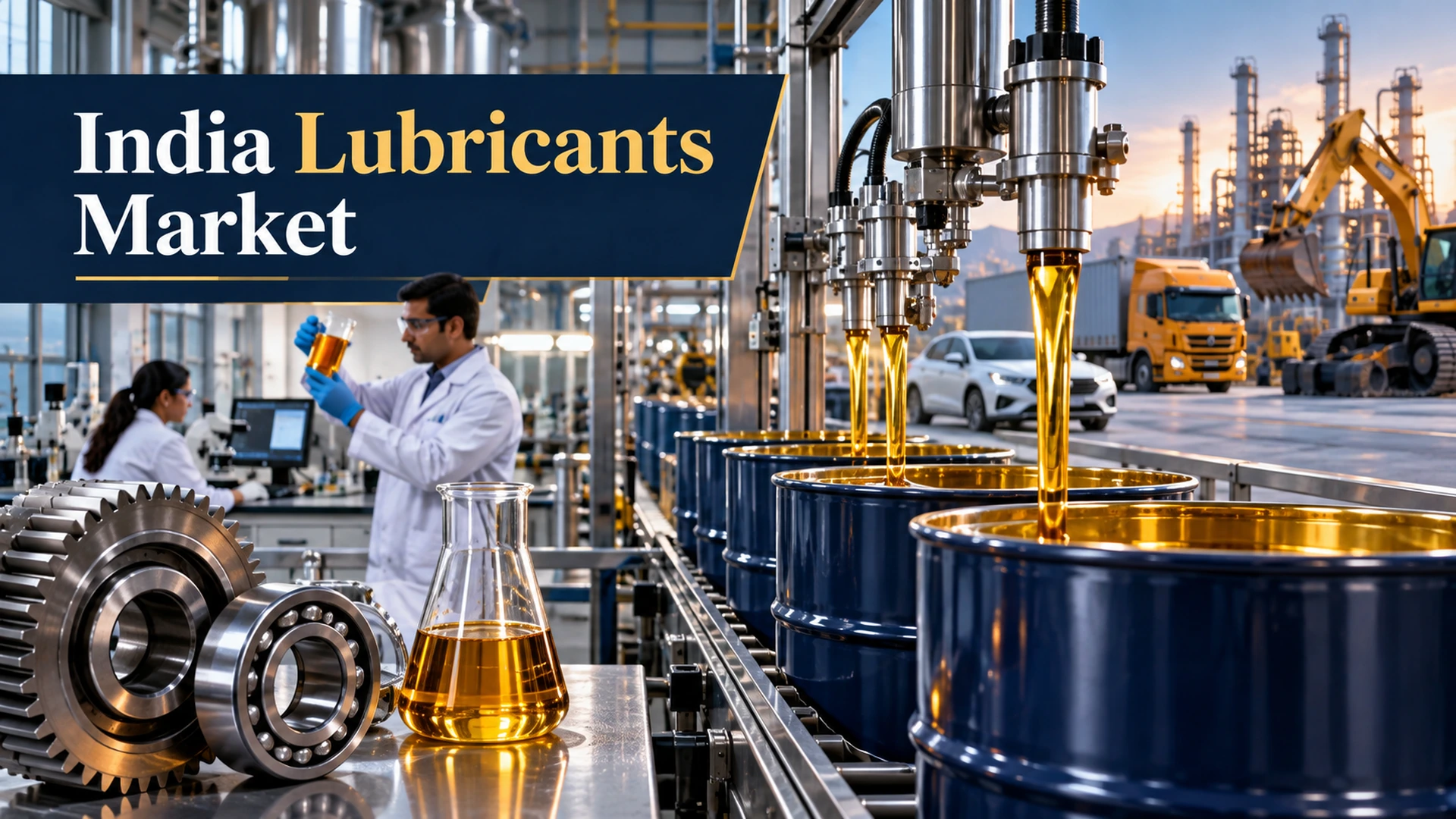
The India Lubricants Market is shifting from pure volume expansion to a value‑focused model driven by premium synthetic formulations, EV‑compatible fluids and circular re‑refining. India Lubricants Market is projected to grow from USD 6,445 million in 2025 to USD 8,216 million by 2032, reflecting a slower 3.53% forecast CAGR compared with the historical 5.81% CAGR (2020‑2025). The slowdown is attributed to longer drain intervals, improved lubricant durability and drivetrain electrification, which curb litre‑per‑vehicle consumption while higher‑value formulations lift revenue per litre.
Why Is Premium Synthetic Penetration Important for the India Lubricants Market?
Impact on Market Demand
Domestic two‑wheeler sales reached 21.7 million units in FY2025‑26 and passenger‑vehicle sales hit 4.64 million units, sustaining a robust replacement base for engine, transmission and drivetrain lubricants. At the same time, synthetic and semi‑synthetic mix stood at 34.0% in 2025 and is expected to rise toward 46% by 2032, propelled by tighter OEM specifications and the rise of electric passenger‑vehicle registrations (over 100,000 units in FY2024‑25, up 18.2%). This blend shift fuels demand for higher‑priced, performance‑oriented products.
Impact on Competition
Major national suppliers are expanding blending capacity—e.g., a new facility in Raigad designed for 159,000 kiloliters annually—and leveraging extensive depot networks across western and southern corridors. The concentration of blending infrastructure lowers logistics costs for high‑volume automotive and industrial corridors, raising entry barriers for smaller players lacking scale and OEM approvals. Companies that secure new OEM approvals (58 in FY2024‑25) and broaden formulation portfolios gain competitive advantage.
Impact on Market Growth
Value creation is increasingly decoupled from litre growth. Physical demand is modelled to rise modestly (≈3.1% annually), while value growth benefits from premiumization, synthetic penetration and specialized industrial products. Implied ASP climbed to USD 1.15 per litre in 2025, reflecting the shift toward formulation sophistication and lifecycle economics.
What Does the Ken Research Report Reveal About Market Opportunities?
Premium Synthetic and EV‑Compatible Fluids
EV passenger‑vehicle registrations grew 18.2% in FY2024‑25, creating a nascent demand pool for transmission fluids, low‑viscosity thermal‑management fluids and greases that meet electric‑drivetrain requirements. A leading supplier’s launch of advanced EV lubricants and 58 new OEM approvals in FY2024‑25 illustrates the commercial upside of early specification access.
Used‑Oil Re‑Refining and Circular Products
Extended Producer Responsibility (EPR) targets rise from 20% in FY2025‑26 to 60% from FY2029‑30, driving investment in formal collection, recycling credits and re‑refined base stocks. Companies with integrated recovery or recycler partnerships can monetize circular feedstock and meet regulatory mandates, turning compliance into a revenue stream.
Industrial Hydraulic and Gear Fluids
Capital‑goods output grew 14.2% in June 2026 and infrastructure production expanded 7.5% in the same month, boosting demand for hydraulic fluids, gear oils and metalworking fluids. These specification‑intensive segments offer higher margins than commodity engine oils.
What Does the Market Shift Mean for Businesses?
Aftermarket and Recurring Revenue Opportunities
Interpretation: The report suggests that firms should pivot from pure volume sales to higher‑margin aftermarket services, such as extended drain‑interval products (up to 15,000 km) and OEM‑approved formulations. Premium pricing and service contracts can offset reduced litre consumption per vehicle.
Market Adoption and Execution Challenges
Interpretation: Companies face challenges from base‑oil import exposure (USD 2.7 billion imports in FY2021‑22), customs duties (5% basic duty, 18% GST) and wholesale‑price inflation (8.3% in April 2026). Managing input‑cost volatility while maintaining margin resilience will require diversified sourcing, inventory discipline and strategic pricing.
What Should India Lubricants Market Participants Watch Next?
- Acceleration of synthetic and semi‑synthetic penetration toward 46% by 2032
- Regulatory evolution of EPR targets and associated credit markets
- Growth of EV‑compatible fluid specifications and OEM approvals
- Potential consolidation among blending players to enhance scale and distribution reach
- Impact of longer drain intervals on litre demand and premium pricing strategies
How Can Businesses Apply These Market Findings?
Firms operating in the Indian lubricants space should translate the projected shift toward premium synthetic and semi‑synthetic formulations into a clear product‑development roadmap. The forecast indicates that the synthetic‑and‑semi‑synthetic mix will rise from 34.0% in 2025 toward 46% by 2032, driven by tighter OEM specifications and the expanding electric‑vehicle (EV) fleet. Companies that embed this mix‑target into their blending strategies can capture the incremental value per litre that is already reflected in the implied ASP of USD 1.15 in 2025. Practical steps include expanding high‑performance base‑oil slots, securing additional OEM approvals—building on the 58 approvals recorded in FY2024‑25—and co‑creating EV‑compatible thermal‑management fluids with vehicle manufacturers. By aligning product portfolios with the anticipated EV‑driven demand for low‑viscosity transmission and gear fluids, firms can lock in early‑stage market share before the EV registration base scales further.
Interpretation: The report suggests that firms should pivot from pure volume sales to higher‑margin aftermarket services, such as extended drain‑interval products (up to 15,000 km) and OEM‑approved formulations. Premium pricing and service contracts can offset reduced litre consumption per vehicle.
Investors and operators must also prioritize circularity as a growth lever. The Extended Producer Responsibility (EPR) framework will push collection and re‑refining targets from 20% in FY2025‑26 to 60% from FY2029‑30. Companies that embed formal oil‑collection networks, partner with certified recyclers, or develop in‑house re‑refining capacity can monetize the circular feedstock and meet regulatory mandates while differentiating on sustainability. The financial upside emerges from credit mechanisms linked to EPR compliance and from the higher margin associated with re‑refined base stocks, which can be blended into premium formulations without sacrificing performance.
Interpretation: Companies with integrated recovery or recycler partnerships can monetize circular feedstock and meet regulatory mandates, turning compliance into a revenue stream.
Industrial segments—hydraulic fluids, gear oils, and metalworking fluids—are poised for margin expansion as capital‑goods output grew 14.2% in June 2026 and infrastructure production rose 7.5% in the same month. Business units should therefore allocate R&D resources toward formulation robustness, temperature stability, and load‑bearing capacity that meet the specifications of heavy‑equipment manufacturers. Leveraging the concentrated blending infrastructure in Maharashtra, particularly the new 159,000‑kiloliter facility in Raigad, can reduce logistics costs and improve inventory turns for these high‑value products. Strategic distribution partnerships across western and southern corridors will further enhance serviceability for industrial customers who demand rapid replenishment and technical support.
Interpretation: The concentration of blending infrastructure lowers logistics costs for high‑volume automotive and industrial corridors, raising entry barriers for smaller players lacking scale and OEM approvals.
Conclusion: India Lubricants Market Outlook
The India Lubricants Market is poised for modest value growth, underpinned by premium synthetic adoption, EV‑compatible fluid development and circular re‑refining initiatives. While physical litre growth moderates, higher ASPs and specialized industrial demand create resilient revenue pathways for firms that invest in technology, OEM partnerships and compliant recycling infrastructure.