
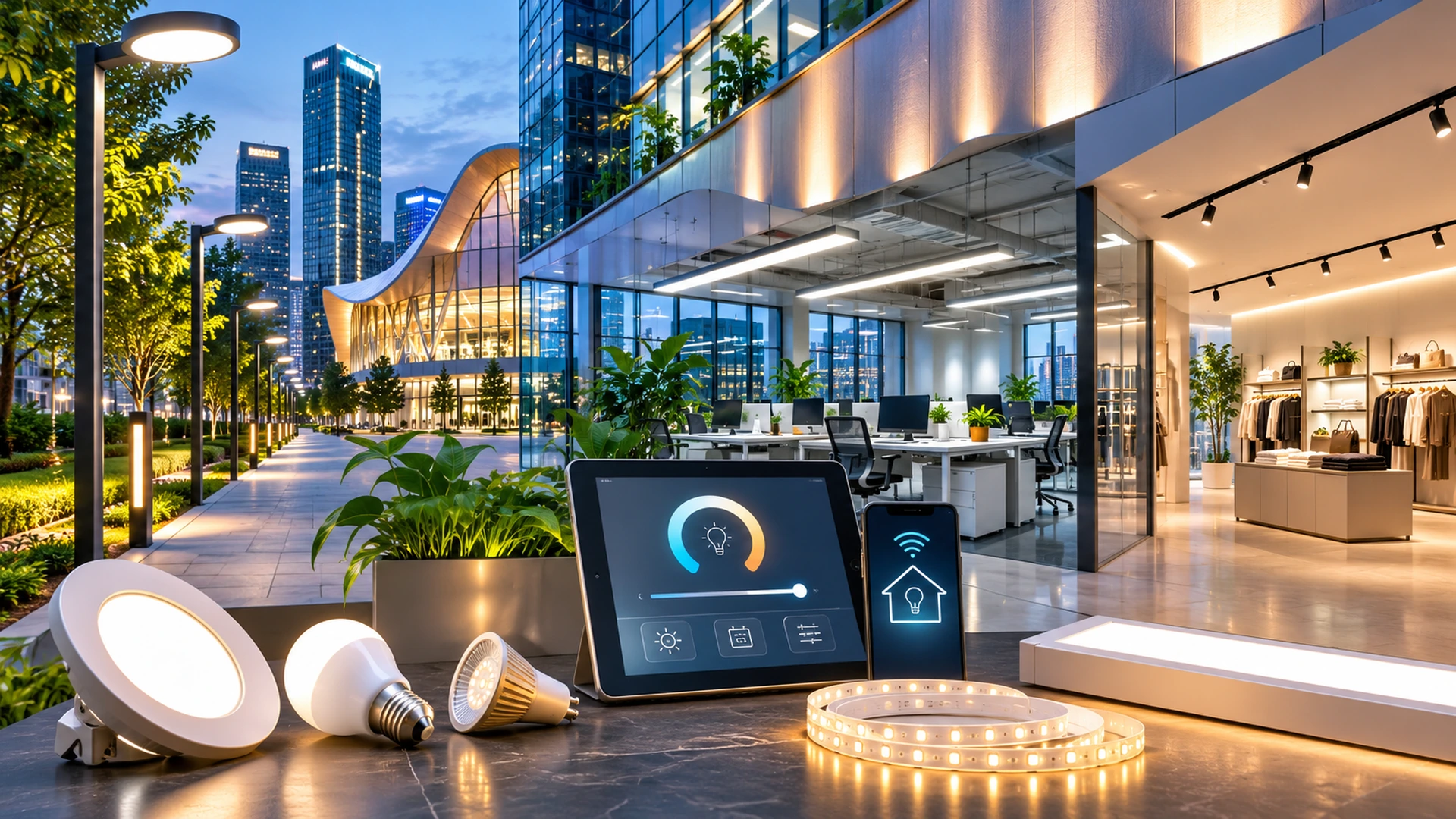
At a Glance
- Market value: USD 91 billion in 2025
- Projected value: USD 161,045 million by 2032
- Forecast CAGR: 8.50% (2025‑2032)
- Unit volume: 13.75 billion units in 2025, 18.46 billion units by 2032
- Dominant region: Asia Pacific (39.9% of global value in 2025)
What Is Changing in the Global LED Lighting Market?
The market is shifting from first‑time LED conversion toward higher‑specification replacement and controls‑led revenue pools, creating a pronounced premiumization effect. Global LED Lighting Market value is expected to climb from USD 91,000 million in 2025 to USD 161,045 million in 2032, while unit growth slows, widening the blended ASP from USD 6.62 per unit in 2025 to USD 8.72 by 2032.
Why Is Premiumization Important for the Global LED Lighting Market?
Impact on Market Demand
Replacement demand is becoming a larger strategic pool: approximately 5.8 billion units reached replacement age in 2024, and 6.05 billion units are modeled for replacement in 2025. As installed LED stock ages, buyers seek higher‑efficacy, sensor‑integrated and tunable systems, driving demand for professional‑grade luminaires rather than commodity bulbs.
Impact on Competition
Suppliers that rely solely on commodity lamps face pricing pressure, evidenced by an adjusted EBITA margin decline to 8.9% in 2025 from 9.9% in 2024. Companies with strong controls, IoT integration and premium product portfolios are better positioned to capture the higher‑value share of the market, especially in commercial and public‑infrastructure projects.
Impact on Market Growth
The forecasted 8.50% value CAGR outpaces the slower unit‑volume CAGR, confirming that value growth is increasingly driven by mix improvement. Connected/IoT LED technology is identified as the strongest growth engine, expanding addressable value beyond fixtures into software‑enabled services.
What Does the Ken Research Report Reveal About Market Opportunities?
Fastest‑Growing Segment: Connected/IoT LED
Connected lighting accounts for the most rapid expansion within the technology dimension, as buyers integrate occupancy sensing, building‑automation and energy‑analytics. One leading supplier reported 167 million connected light points at the end of 2025, illustrating the scale of this shift.
Regional Opportunity: Asia Pacific
Asia Pacific holds a 39.9% share of global LED lighting value in 2025 and a benchmark CAGR of 8.4% through 2032, outpacing Europe (7.8%) and North America (7.5%). High adoption rates—above 85% in China and 75% in India—provide scale advantages in production, distribution and specification‑led project delivery.
Product‑Type Opportunity: Premium Professional Luminaires
Premium professional LEDs can exceed 200 lumens per watt versus about 100 lumens per watt for typical products, enabling defensible specification tiers and higher ASPs. The blended ASP is projected to reach USD 8.72 per unit by 2032, reflecting this premiumization.
What Does the Market Shift Mean for Businesses?
Aftermarket and Recurring Revenue Opportunities
Interpretation: The report suggests that firms should pivot toward aftermarket services, lighting‑as‑a‑service models and retrofit financing, leveraging the estimated 5.8 billion replacement‑age units and the growing demand for sensor‑integrated upgrades.
Market Adoption and Execution Challenges
Interpretation: Companies must navigate price compression on commodity lamps and the upfront cost premium of advanced controls, which can extend payback periods for smaller building owners. Interoperability across 110‑country efficiency standards also adds complexity to product development.
What Should Global LED Lighting Market Participants Watch Next?
- Regulatory phase‑outs accelerating replacement cycles in key jurisdictions (e.g., EU, California)
- Growth of connected‑lighting revenue as IoT integration matures
- Emerging‑market retrofit demand, especially in regions where 30% of residential lamps remain non‑LED
- Supply‑chain dynamics in Asia Pacific, where manufacturing scale supports rapid product iteration
- Evolution of Lighting‑as‑a‑Service contracts tied to performance‑based energy savings
How Can Businesses Apply These Market Findings?
Companies that have built their revenue primarily on low‑cost LED bulbs must re‑evaluate product roadmaps in light of the widening gap between unit‑volume growth and value growth. The forecast shows blended ASP rising from USD 6.62 in 2025 to USD 8.72 by 2032, a premiumization trajectory driven by sensor integration, tunable optics and connected controls. Interpretation: firms should accelerate development of modular luminaires that can be retrofitted with IoT‑enabled drivers, allowing a single hardware platform to generate recurring software‑as‑a‑service fees. By bundling hardware with analytics dashboards, businesses can capture higher‑margin recurring revenue while meeting the replacement‑age demand of an estimated 5.8 billion units that reached end‑of‑life in 2024.
Geographic focus is equally critical. Asia Pacific accounts for 39.9% of global LED lighting value in 2025 and enjoys adoption rates above 85% in China and 75% in India. This scale creates a cost advantage in component sourcing and enables rapid iteration of high‑specification products. Interpretation: multinational suppliers should deepen local partnerships with distributors and engineering firms in the region, leveraging the existing manufacturing ecosystem to launch premium professional luminaires at competitive cost. Simultaneously, they can use the region’s extensive project pipeline—particularly in commercial buildings and public‑infrastructure upgrades—to pilot connected‑lighting pilots that showcase energy‑saving outcomes and generate data for future contract negotiations.
The commercial end‑user segment remains the dominant revenue pool, and its buyers are increasingly seeking integrated energy‑management solutions rather than isolated lamp replacements. The report highlights that controls‑led revenue pools are expanding faster than pure lamp sales, with connected/IoT LED identified as the strongest growth engine. Interpretation: original equipment manufacturers (OEMs) should embed open‑protocol communication stacks (e.g., BACnet, MQTT) into their fixtures, ensuring interoperability across the 110‑country efficiency standards referenced in the market outlook. This technical readiness reduces integration risk for building‑automation projects and positions the OEM as a preferred supplier for large‑scale retrofits.
Financial structuring also evolves as the market matures. The shift toward higher‑specification replacements raises upfront capital requirements, but also creates opportunities for financing models such as Lighting‑as‑a‑Service (LaaS) and performance‑based contracts. Interpretation: firms with strong balance sheets or access to green‑bond capital can offer turnkey retrofit packages, where the client pays over the life of the installation from verified energy‑savings. This aligns cash‑flow timing with the longer payback periods of premium systems and mitigates the price‑compression pressure observed on commodity lamps, where EBITA margins fell to 8.9% in 2025.
Finally, supply‑chain resilience must be addressed. While Asia Pacific provides manufacturing scale, geopolitical tensions and raw‑material constraints can disrupt component availability, especially for advanced drivers and sensors. Interpretation: diversifying sourcing across multiple Asian hubs and establishing strategic inventory buffers for critical IoT modules will safeguard product launch timelines. Companies that can reliably deliver integrated, high‑efficacy solutions at scale will be best positioned to capture the incremental value embedded in the forecast 8.50% CAGR through 2032.
Conclusion: Global LED Lighting Market Outlook
The Global LED Lighting Market is set to more than double in value by 2032, driven by a transition to premium, connected solutions and a robust replacement‑age pool. While unit growth moderates, the premiumization of products and regional momentum in Asia Pacific create fertile ground for firms that can blend high‑efficacy hardware with smart‑control services.