UK Agricultural Machinery Market Shifts Toward Precision-Led Growth
At a Glance
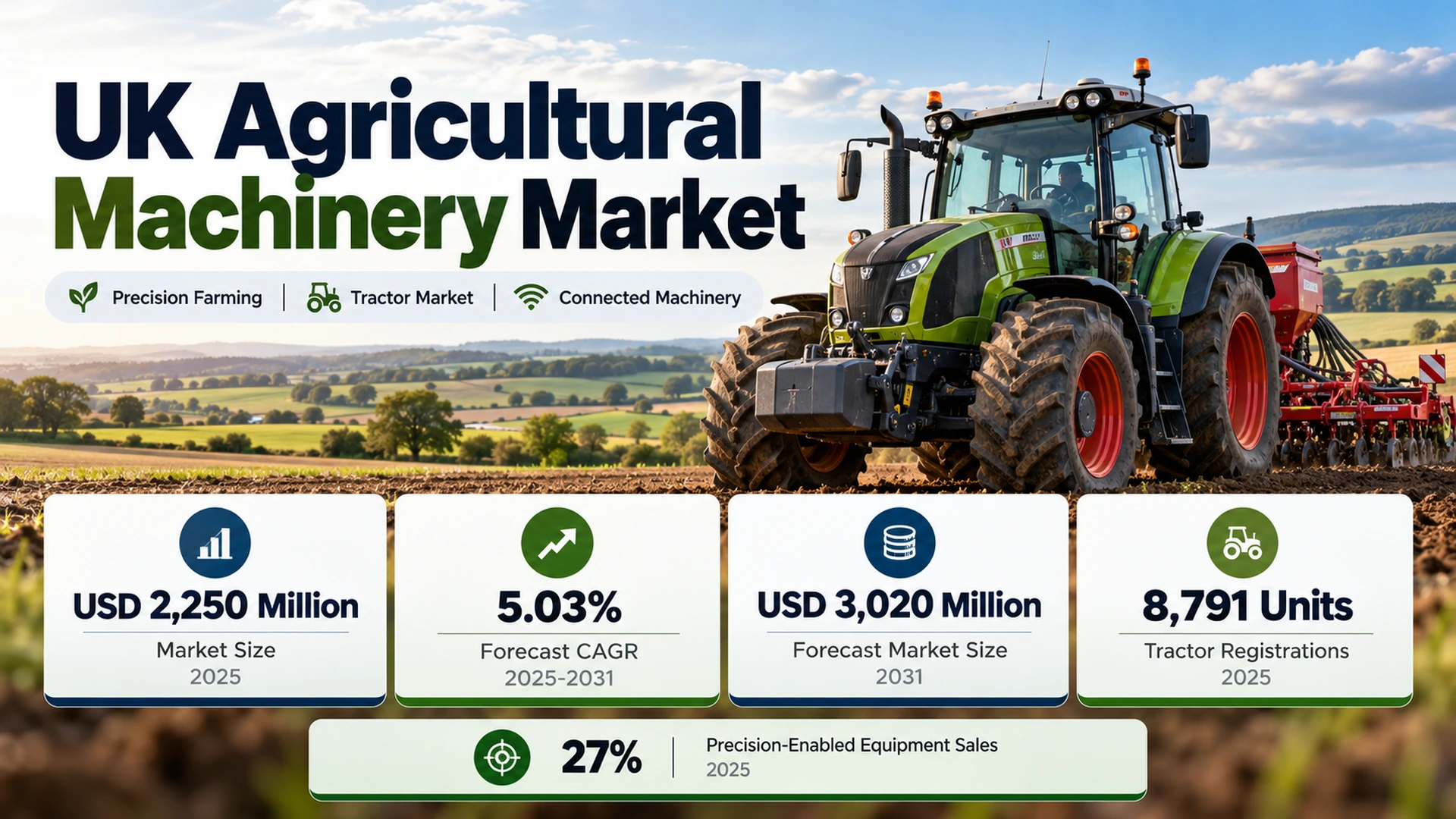
- The UK Agricultural Machinery Market was valued at USD 2,250 million in 2025 and is projected to reach USD 3,020 million by 2031, representing a forecast CAGR of 5.03%.
- Ken Research identifies precision-enabled tractors and implements as the fastest-growing area over the forecast period.
- Tractor registrations reached 8,791 units in 2025, which the report describes as a multi-decade low.
- CNH Industrial N.V., Deere & Company and AGCO Corporation represented approximately 79% of UK tractor registrations in 2024.
- Precision-enabled equipment represented an estimated 27% of market sales in 2025.
- Growth opportunities are increasingly linked to precision technology, connected machinery, retrofit systems, aftermarket services and recurring digital revenue.
What Is Changing in the UK Agricultural Machinery Market?
The most significant development identified by Ken Research is a structural change in how the UK Agricultural Machinery Market generates value.
The UK Agricultural Machinery Market was valued at USD 2,250 million in 2025 and is projected to reach USD 3,020 million by 2031, representing a forecast CAGR of 5.03%. Ken Research identifies precision-enabled tractors and implements as the fastest-growing area over the forecast period.
The market is moving beyond conventional equipment replacement. Connected machinery, precision guidance, computer-vision systems and advanced powertrains are expected to increase revenue generated per machine. At the same time, software subscriptions, maintenance contracts, telematics, parts and dealer-provided optimisation services are becoming more important components of the commercial model.
This technology-led transition also increases the relevance of precision farming technologies within modern agricultural equipment and farm operations.
The transition follows a period of weaker machinery purchasing. Tractor registrations reached 8,791 units in 2025, which the report describes as a multi-decade low, highlighting delayed replacement spending and greater dealer inventory risk.
Why Is Precision Technology Important for the UK Agricultural Machinery Market?
Precision technology is becoming an important source of differentiation because agricultural machinery suppliers can increasingly generate value through productivity improvements, digital functionality and lifecycle services rather than relying only on new-equipment replacement.
Impact on Agricultural Machinery Demand
Ken Research identifies labour substitution and farm productivity as important growth drivers.
Autonomous guidance, robotic feeding and machine vision can reduce repetitive labour requirements, while higher-productivity machinery can allow operators to manage larger areas per employee.
Crop care and input application is identified as the strongest application sub-segment. Variable-rate technology, camera-guided mechanical weeding, low-drift spraying and precision fertiliser spreading support investment by improving operating efficiency while creating additional hardware, software and service opportunities.
These trends reinforce the strategic role of precision agriculture in the wider agricultural machinery ecosystem.
Impact on Agricultural Machinery Competition
Competition in the UK Agricultural Machinery Market is concentrated among multinational tractor and full-line equipment groups, while specialist implement categories remain more fragmented.
CNH Industrial N.V., Deere & Company and AGCO Corporation represented approximately 79% of UK tractor registrations in 2024. Ken Research also identifies Kubota Corporation and CLAAS KGaA mbH among prominent market participants.
Competition therefore extends beyond the physical machinery portfolio. Dealer networks, financing capabilities, technology integration, aftermarket coverage and service bundling are increasingly important commercial considerations.
For broader regional context, readers can also explore the Europe Agricultural Equipment Market.
Impact on UK Agricultural Machinery Market Growth
Ken Research expects market value growth to be supported by higher technology content, software functionality and service attachment.
Precision-enabled equipment represented an estimated 27% of market sales in 2025, indicating that connected and productivity-focused technologies are becoming an increasingly important revenue and differentiation lever.
The trend also creates greater overlap between conventional machinery manufacturing and the wider agritech market, particularly around digital systems, automation and connected equipment.
What Does the Ken Research Report Reveal About Market Opportunities?
The report highlights opportunities across product categories, applications, retrofit technologies and lifecycle services.
Tractors Remain a Major Revenue Pool
Tractors constitute the largest individual revenue pool within the market.
Their commercial importance means replacement cycles, financing availability, dealer inventories and technology upgrades remain central to the performance of agricultural machinery suppliers.
Crop Care and Input Application Offer Growth Potential
Crop care and input application is identified as a strong opportunity because precision technologies can improve efficiency while supporting targeted use of farm inputs.
Variable-rate application, camera-guided mechanical weeding and low-drift spraying also expand opportunities for equipment suppliers to add software, data and service functionality around physical machinery.
Retrofit Precision Systems Expand the Addressable Market
Ken Research identifies commercial potential in upgrading existing farm machinery.
Guidance kits, machine vision, variable-rate controls and telematics can be fitted to existing equipment at lower capital cost than complete replacement. These solutions can support hardware margins, installation revenue, software subscriptions and agronomic data-service opportunities.
Businesses evaluating related equipment opportunities can also review the Global Agricultural Equipment Market.
What Does the Market Shift Mean for Agricultural Machinery Businesses?
The report suggests that competitive advantage will increasingly depend on combining machinery with technology, financing, digital services and responsive aftermarket support.
Manufacturers and dealers with strong workshops, diagnostic capability, parts availability and digital-service offerings may be better positioned to reduce dependence on volatile new-equipment cycles.
Aftermarket Services Can Create Recurring Revenue
Ken Research identifies opportunities in fixed-price servicing, preventive maintenance, seasonal uptime guarantees, parts subscriptions and remote diagnostics.
These offerings can strengthen customer relationships while generating revenue throughout the operating lifecycle of agricultural equipment.
Technology Adoption Still Faces Commercial Barriers
Ken Research identifies weak farm confidence, high equipment and financing costs, technology-integration difficulties, skills gaps, mixed-brand interoperability and rural connectivity constraints as barriers to adoption.
Market participants therefore need to balance advanced technology with affordability, practical usability and compatibility with existing machinery fleets.
What Should UK Agricultural Machinery Market Participants Watch Next?
Market participants should monitor several report-supported themes:
- Precision retrofits: Guidance, telematics, machine vision and variable-rate systems can expand technology adoption without requiring complete machinery replacement.
- Aftermarket and uptime services: Maintenance, diagnostics, servicing and parts support can create recurring revenue opportunities.
- Crop-care technology: Targeted application and mechanical weeding remain important areas for productivity-focused investment.
- Contracting and machinery sharing: These models can improve equipment utilisation where direct ownership economics are less attractive.
- Technology integration: Technician availability, interoperability and rural connectivity can influence the pace of connected-equipment adoption.
- Digital service expansion: Software, telematics and data-driven services can increase commercial value beyond the initial machinery transaction.
Conclusion: UK Agricultural Machinery Market Outlook
The UK Agricultural Machinery Market is evolving into a more technology- and service-intensive industry. Precision equipment, connected systems, retrofit solutions and aftermarket services are becoming increasingly important to how manufacturers and dealers create value.
Ken Research indicates that businesses capable of combining machinery with digital capabilities, financing, diagnostics and lifecycle support may be better positioned to capture future opportunities. However, affordability, farm confidence, integration complexity and infrastructure constraints will remain important considerations influencing the pace of market development.