
At a Glance
- Market value: USD 26,220 million in 2025
- Projected value: USD 38,907 million by 2032
- Forecast CAGR: 5.80% (2025-2032)
- Transaction volume: 1.90 million units in 2025, rising to 2.585 million by 2032
- Average transaction price: USD 13,800 in 2025, increasing to USD 15,051 by 2032
What Is Changing in the Indonesia Used Car Market?
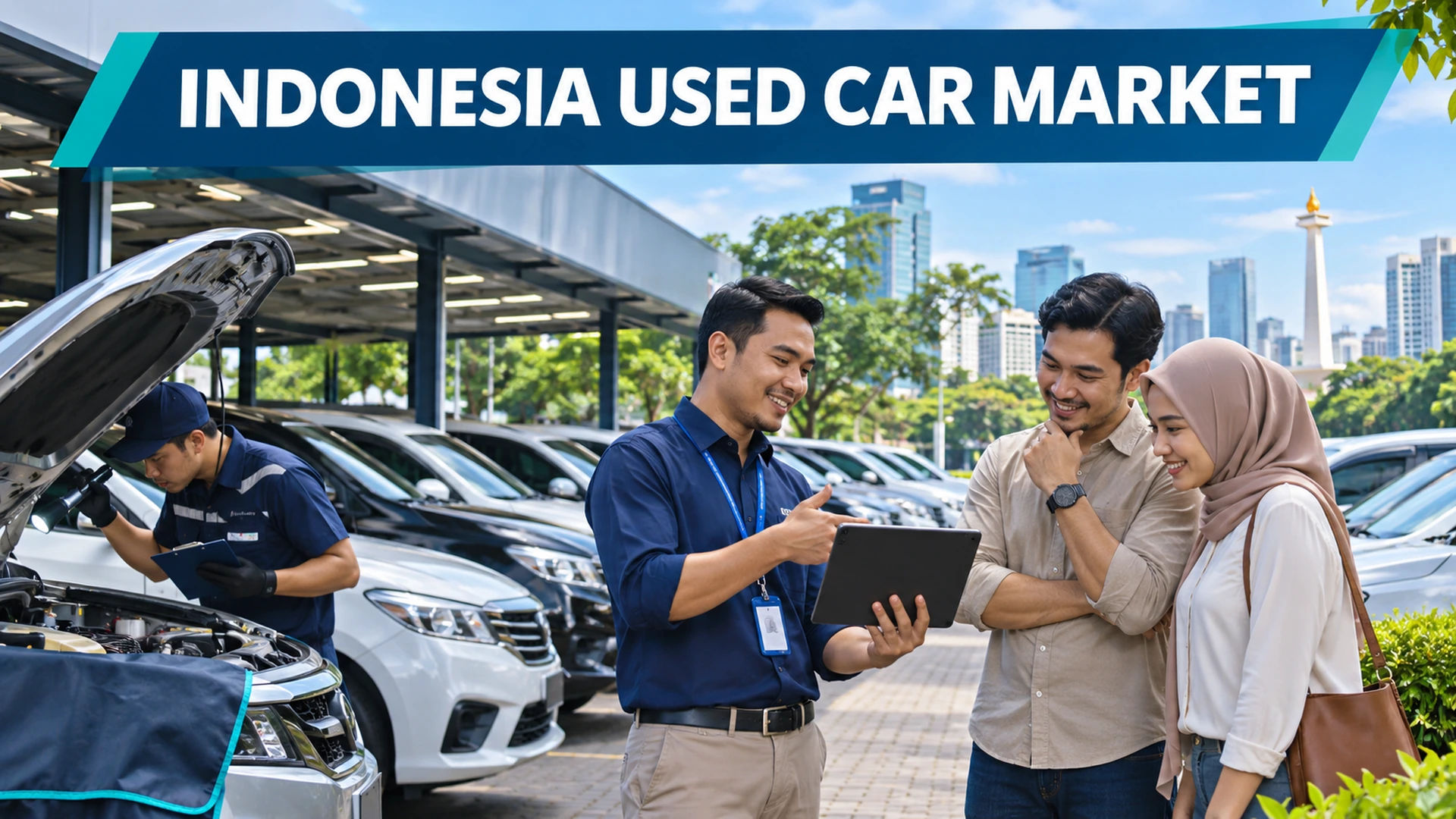
The Indonesia Used Car Market is shifting from pandemic‑driven recovery to a quality‑focused growth model, as outlined in the Indonesia Used Car Market report. While historical growth averaged 8.36% (2020‑2025), the forecasted 5.80% CAGR reflects a transition toward higher‑priced, better‑certified inventory, deeper financing integration, and omnichannel retailing.
Why Is Quality‑Driven Growth Important for the Indonesia Used Car Market?
Impact on Market Demand
Demand is increasingly anchored in affordability‑led substitution, with national used‑car sales rising roughly 5% year‑on‑year through September 2025. The GDP per capita of USD 5,083.4 in 2025 sustains motorization appetite while keeping price sensitivity high. As average transaction prices climb from USD 13,800 to USD 15,051, buyers gravitate toward certified pre‑owned vehicles that promise lower maintenance risk and clearer residual values.
Impact on Competition
Organized retailers such as OLXmobbi, CARSOME, and CARRO are leveraging extensive inspection protocols—175‑point and 160‑point checks respectively—and warranty packages to differentiate from fragmented independent dealers. Their combined share of organized vendors reached 33.8% in 2025, indicating that trust‑building services are becoming a decisive competitive lever.
Impact on Market Growth
The premium on value versus volume is evident: transaction volume grows at ~4.5% annually, yet market value expands at 5.80% CAGR, driven by mix upgrades toward MPVs, SUVs, and emerging electric powertrains. This premium underscores the strategic importance of inventory quality, financing conversion, and certification in sustaining growth beyond the post‑pandemic rebound.
What Does the Ken Research Report Reveal About Market Opportunities?
Fastest‑Growing Segment: Digital Retail and Classified Platforms
Digital discovery remains a catalyst, with OLXmobbi selling 33,100 used cars—a 21% increase in 2025. Platforms that blend online lead generation with physical inspection, test‑drive, and warranty fulfillment are poised to capture a larger share of the expanding transaction pool.
Vehicle‑Type Opportunity: MPVs and SUVs
MPVs continue to dominate household mobility, while SUVs and crossovers lift the average transaction price. Dealers that align sourcing with these high‑value segments can benefit from stronger gross margins and better residual‑value discipline.
Powertrain Transition: Hybrid and Battery‑Electric Vehicles
BEV wholesales reached 40,151 units and PHEV sales 4,312 units by November 2025, representing 11.62% of national new‑vehicle wholesales. Early investment in battery‑health certification and EV‑specific warranties will position retailers to capture the forthcoming secondary‑market of electrified vehicles.
Regional Opportunity: Greater Jakarta and Java Corridors
Java contributed 56.93% of Indonesia’s economy in 2025 and recorded 5.30% growth, making it the core commercial battleground. Concentrated dealer clusters, financing access, and inspection infrastructure create a fertile environment for scaled operators seeking inventory turnover and higher transaction quality.
What Does the Market Shift Mean for Businesses?
Aftermarket and Recurring Revenue Opportunities
Interpretation: The report suggests that organized retailers can monetize trust through extended warranties, refurbishment services, and finance‑linked aftersales. Certified programs (e.g., CARSOME’s one‑year warranty) generate recurring revenue streams that offset tighter margins on vehicle sales.
Market Adoption and Execution Challenges
Interpretation: Credit selectivity—down‑payment requirements of at least 10% and a gross NPF of 2.87% (Feb 2025)—poses a conversion hurdle for price‑sensitive buyers. Operators must balance aggressive inventory acquisition with disciplined underwriting to avoid credit‑quality deterioration.
What Should Indonesia Used Car Market Participants Watch Next?
- Evolution of embedded finance models and 0% down‑payment financing structures.
- Regulatory impact of the 0% BBNKB tax on trade‑ins in Jakarta (effective 5 Jan 2025).
- Scaling of certified‑pre‑owned standards across smaller dealers.
- Growth of EV‑related resale infrastructure and battery‑health certification.
- Geographic expansion beyond Java to capture inter‑island demand.
How Can Businesses Apply These Market Findings?
Interpretation: Operators seeking to capture the projected expansion from USD 26,220 million in 2025 to USD 38,907 million by 2032 must first align inventory acquisition with the emerging premium on transaction quality. The forecast shows average realized prices climbing from USD 13,800 to USD 15,051 per vehicle, driven by younger stock, higher‑value MPV and SUV mixes, and certified‑pre‑owned premiums. Consequently, dealers should prioritize sourcing vehicles that meet stringent inspection criteria and possess clear service histories, as these attributes directly support higher resale values and stronger residual‑value discipline. By embedding comprehensive 175‑point or 160‑point checks into the intake process, firms can differentiate themselves from fragmented independents, command price premiums, and reduce post‑sale warranty claims.
Interpretation: Financing integration represents the second lever for sustainable growth. The market narrative highlights deeper financing penetration, yet credit selectivity remains a hurdle, with down‑payment thresholds of at least 10 % and a gross non‑performing‑loan ratio of 2.87 % recorded in February 2025. Businesses that partner with financial institutions to offer embedded finance solutions—such as zero‑percent down‑payment schemes or flexible loan‑to‑value ratios—can broaden the addressable buyer base while managing risk through rigorous underwriting. Structured finance products that bundle warranty extensions or refurbishment services further enhance cash‑flow stability, turning what is traditionally a margin‑compressing activity into a recurring‑revenue stream.
Interpretation: Geographic concentration on Greater Jakarta and the broader Java corridors demands an omnichannel operating model that blends digital discovery with physical execution. While digital platforms continue to generate leads, the winning formula now incorporates on‑ground inspection bays, test‑drive facilities, and standardized fulfillment across multiple metropolitan markets. Firms that invest in regional hub networks can achieve faster stock turnover, leveraging Java’s 56.93 % contribution to national GDP and its 5.30 % growth rate in 2025. This approach also mitigates inventory aging, a critical metric given the forecasted volume increase to 2.585 million units by 2032.
Interpretation: Finally, early adoption of electrified‑vehicle certification will become a competitive differentiator as hybrid and battery‑electric models begin to populate the secondary market. By establishing battery‑health assessment protocols and EV‑specific warranty packages now, retailers position themselves to capture the nascent resale segment of BEVs and PHEVs, which already accounted for 11.62 % of new‑vehicle wholesales by November 2025. This forward‑looking capability not only aligns with the gradual electrification trend but also enhances brand perception among environmentally conscious consumers, further supporting premium pricing.
Interpretation: The convergence of higher‑priced inventory, integrated financing, omnichannel execution, and EV‑ready services creates a strategic premium that rewards operators with disciplined execution. Companies that embed these levers into their core business model are likely to outperform peers as the Indonesia Used Car Market transitions from pandemic‑driven recovery to quality‑focused expansion.
Conclusion: Indonesia Used Car Market Outlook
The Indonesia Used Car Market is set to grow from USD 26,220 million in 2025 to USD 38,907 million by 2032, driven by higher‑value inventory, digital‑enabled omnichannel retailing, and expanding financing depth. Operators that invest in certification, warranty services, and EV‑ready capabilities will be best positioned to capture premium margins while navigating credit and geographic challenges.