
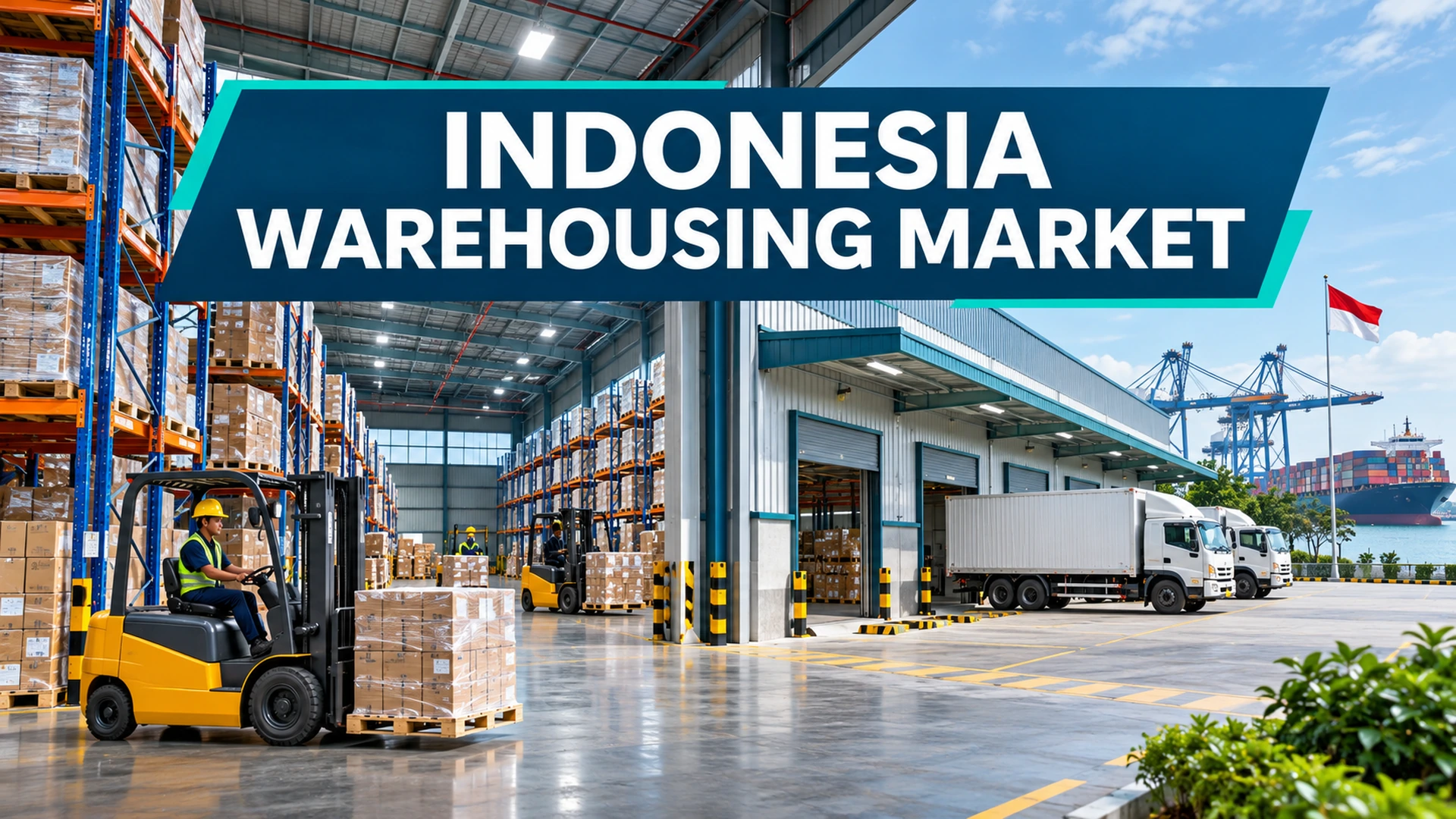
At a Glance
- Market value: USD 3,340 million in 2025
- Forecast size: USD 5,663 million by 2031
- Forecast CAGR: 9.20% (2026‑2031)
- Dominant region: Java (56.93% of Indonesia’s economy in 2025)
- Fastest‑growing segment: Cold‑storage and value‑added fulfillment services
What Is Changing in the Indonesia Warehousing Market?
The Indonesia Warehousing Market is shifting from a passive space‑rental model to a high‑value, transaction‑linked service platform, as e‑commerce logistics created a multi‑billion‑dollar demand pool in 2025 and online retailers increasingly require decentralized inventory, returns processing and same‑day dispatch. Indonesia Warehousing Market operators are responding by adding fulfillment, inventory‑visibility and cold‑chain capabilities that lift revenue per square meter while occupancy stays above 92%.
Why Is E‑Commerce Fulfillment Important for the Indonesia Warehousing Market?
Impact on Market Demand
E‑commerce growth boosted marketplace transaction volume by 29.16% in 2023, creating a need for item‑level picking, packing and returns handling. This intensifies service revenue, especially in multi‑user facilities near Greater Jakarta, Surabaya, Medan and secondary hubs, where inventory can be positioned to meet faster‑delivery commitments.
Impact on Competition
Operators that combine storage with advanced Warehouse Management Systems (WMS), cross‑docking and real‑time visibility can command premium rates. The report notes that operators lacking scale, compliance systems or automation will face margin compression from labor, energy and land costs, giving an edge to platforms with expandable land banks and high customer retention.
Impact on Market Growth
Revenue growth is expected to outpace physical‑capacity expansion because service intensity per occupied square meter will rise. The forecast CAGR of 9.20% reflects continued growth in organized storage, higher occupancy and an increasing revenue contribution from cold storage, bonded logistics, automated fulfillment and value‑added services.
What Does the Ken Research Report Reveal About Market Opportunities?
Fastest‑Growing Segment: Cold‑Storage and Value‑Added Fulfillment
Cold‑chain facilities command higher effective rates through refrigeration, temperature monitoring and compliance services. Food and beverage demand, which grew 6.15% YoY in Q2 2025, fuels recurring need for dry, chilled and frozen capacity, making cold‑storage the most attractive profit pool.
Regional Expansion Beyond Greater Jakarta
Capacity additions are planned for Surabaya, Medan, Semarang, Makassar and the Kalimantan industrial corridor. After 2028, regional facilities will become increasingly important as operators seek to mitigate land scarcity and congestion in Java while tapping inter‑island logistics demand.
Technology‑Enabled Service Intensification
WMS‑enabled warehousing, automated handling and IoT‑based real‑time visibility are projected to grow faster than manual operations. Integrated WMS and IoT can be deployed across existing facilities with lower capital intensity than full automation, delivering measurable inventory accuracy and shorter order cycles.
What Does the Market Shift Mean for Businesses?
Aftermarket and Recurring Revenue Opportunities
Interpretation: The report suggests that operators focusing on multi‑user fulfillment hubs can monetize storage, handling, packaging and returns fees from multiple tenants, creating a steadier revenue stream and reducing reliance on single‑tenant leases.
Market Adoption and Execution Challenges
Interpretation: High occupancy (single‑digit vacancy) and land scarcity in Java create pressure on rental growth and limit immediate large‑space availability for big occupiers. Smaller operators with fragmented, manual processes may struggle to serve regulated customers, while automation economics remain sensitive to order density.
What Should Indonesia Warehousing Participants Watch Next?
- Scaling cold‑chain capacity to capture premium rates from food, beverage and pharmaceutical customers.
- Developing multi‑user regional fulfillment hubs to spread risk and improve revenue density.
- Investing in WMS, IoT and automated handling to differentiate service levels and justify higher pricing.
- Monitoring land‑bank availability and toll‑road connectivity in emerging corridors outside Java.
- Adapting to high logistics‑cost pressures by improving inventory accuracy and reducing dwell times.
How Can Businesses Apply These Market Findings?
Interpretation: Operators seeking to capture the forecast 9.20% CAGR should prioritize service‑intensity upgrades that lift blended revenue per square meter. The historical trend shows revenue growth outpacing physical‑capacity expansion, driven by e‑commerce fulfillment, cold‑storage, and value‑added services. By integrating Warehouse Management Systems (WMS) with cross‑docking and real‑time inventory visibility, firms can command premium rates while maintaining occupancy above 92%. Interpretation: Companies that invest in modular automation and IoT sensors can increase the blended rate without the capital outlay of full‑scale robotics, thereby improving margin resilience against rising labor and energy costs.
Interpretation: Geographic diversification is another lever. Java contributed 56.93% of Indonesia’s economy in 2025 and hosts the majority of modern logistics space, yet land scarcity and single‑digit vacancy constrain large‑scale expansion. The forecast highlights capacity additions in Surabaya, Medan, Semarang, Makassar and the Kalimantan industrial corridor, especially after 2028. Interpretation: Firms that secure expandable land banks in these secondary corridors will mitigate congestion risks, tap inter‑island logistics demand, and benefit from lower land‑cost premiums, positioning themselves for higher yield on new facilities.
Interpretation: Cold‑chain capabilities represent the fastest‑growing segment, with temperature‑controlled handling delivering higher effective rates. Food and beverage demand grew 6.15% YoY in Q2 2025, underscoring a steady need for dry, chilled and frozen storage. Interpretation: Operators that add or retrofit refrigeration units and obtain relevant compliance certifications can attract premium contracts from food, beverage, and pharmaceutical customers, diversifying revenue streams beyond traditional dry‑goods warehousing.
Interpretation: Multi‑user fulfillment hubs are emerging as a resilient business model. By aggregating several e‑commerce tenants under a single roof, providers can monetize storage, picking, packing, labeling, and returns processing fees from multiple sources, smoothing cash flow and reducing reliance on single‑tenant leases. Interpretation: Companies that design flexible floor plans and offer tiered service packages will capture higher occupancy density while delivering value‑added revenue that cushions against tenant turnover.
Interpretation: Finally, investors and corporate users must monitor regulatory and infrastructure variables. The report notes that operators lacking compliance systems or access to toll‑road networks face margin compression. Interpretation: Proactive engagement with government logistics policies and strategic placement near major transport corridors will safeguard service levels, lower dwell times, and enhance overall supply‑chain resilience for both operators and their corporate clients.
Execution Priorities and Decision Controls
Interpretation: Operators should evaluate projects using service revenue per occupied square meter, fulfillment accuracy and contract retention rather than capacity alone. Occupancy above 92% creates a strong base, but the forecast depends on higher service intensity from picking, packing, returns handling, inventory visibility and temperature-controlled operations. A disciplined scorecard can show whether technology spending is generating premium revenue or merely adding fixed cost.
Interpretation: Regional expansion should follow customer flow and service demand. Surabaya, Medan, Semarang, Makassar and the Kalimantan industrial corridor provide alternatives to Java’s land constraints, while cold-chain demand creates a distinct premium opportunity. Sequencing land commitments, facility fit-out and customer contracts can reduce speculative capacity risk and support the market’s projected 9.20% CAGR through 2031.
Conclusion: Indonesia Warehousing Market Outlook
The Indonesia Warehousing Market is set to expand from USD 3,340 million in 2025 to USD 5,663 million by 2031, driven by a 9.20% CAGR. E‑commerce fulfillment, cold‑chain services and technology‑enabled value‑added offerings will reshape revenue models, while regional expansion and land‑bank strategies will be critical for sustaining growth beyond Java.