
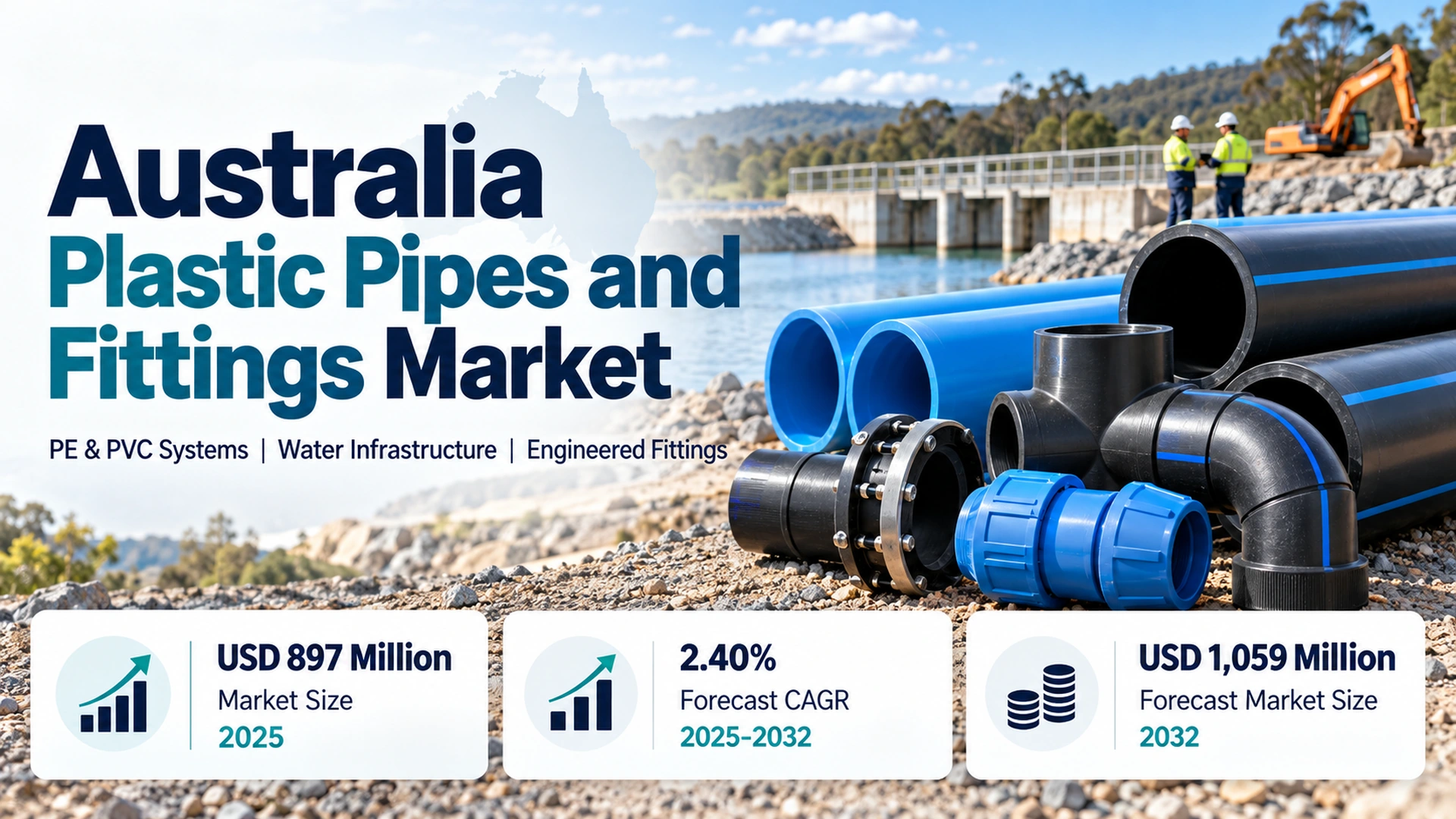
At a Glance
- Market value USD 897 million in 2025
- Projected to reach USD 1,059 million by 2032 (2.40% CAGR)
- PE Pipes and Fittings are the dominant product segment
- New South Wales accounts for 28.0% of national construction activity
- Fittings represent 68% of import value despite only 50% of import volume
What Is Changing in the Australia Plastic Pipes and Fittings Market?
Profit pools are shifting toward engineered fittings and fusion‑compatible PE systems as utilities and large‑scale projects prioritize leak‑free, low‑maintenance networks. The Australia Plastic Pipes and Fittings Market now favours high‑value connection components over bulk pipe volume, a trend reinforced by the 68% share of import value held by fittings in 2024.
Why Is Engineered Fittings Important for the Australia Plastic Pipes and Fittings Market?
Impact on Market Demand
Utilities are replacing ageing water reticulation assets that experience a break roughly every 16 minutes. This replacement cycle creates a steady demand for PE and PVC systems that offer corrosion resistance and long service life. Engineered fittings, especially those compatible with electrofusion and butt‑fusion technologies, enable faster installation and tighter joint integrity, directly supporting the replacement demand.
Residential and commercial construction also benefits from engineered fittings. The March 2026 quarter saw residential construction work rise 5.6% YoY and non‑residential work increase 11.2% YoY, expanding the need for reliable DWV and stormwater connections that engineered fittings can deliver.
Impact on Competition
Domestic manufacturers retain a logistical advantage in bulky pipe logistics, yet the high‑value fitting segment is increasingly contested by imports. In 2024, China supplied 48% of import volume, with fittings accounting for 68% of import value. This concentration forces local players to differentiate through engineered design, certification support, and bundled service offerings.
Top‑tier Australian firms such as Iplex Pipelines Australia and Vinidex Pty Ltd are expanding their engineered‑fitting portfolios to protect market share, while newer entrants (8 in the past five years) are targeting niche high‑specification applications, intensifying competitive pressure.
Impact on Market Growth
The shift toward engineered fittings contributes to the market’s improved growth trajectory. Historical CAGR was 1.08% (2020‑2025), but the forecasted 2.40% CAGR (2025‑2032) reflects higher pricing and mix upgrades driven by fitting sales. The value‑weighted mix improvement is evident as fittings, though only half of import volume, command a premium price.
Furthermore, the projected volume increase from 175.1 thousand tons in 2025 to 206.7 thousand tons in 2032 aligns with a steady replacement demand, while the higher‑margin fitting segment lifts overall revenue growth.
What Does the Ken Research Report Reveal About Market Opportunities?
Fastest‑Growing Product Segment: PE Pipes and Fittings
PE Pipes and Fittings dominate the product landscape and are the fastest‑growing segment. Their flexibility, corrosion resistance, and suitability for electrofusion make them the preferred choice for water, mining, and rural applications.
Suppliers that can offer a full suite of PE pipe, fitting, and jointing solutions are positioned to capture cross‑sell opportunities across residential, utility, and industrial projects.
Technology Opportunity: Electrofusion Jointing
Electrofusion is expected to outpace traditional jointing methods in high‑specification PE networks. Utilities and mining operators prioritize leak integrity and traceability, driving demand for electrofusion‑ready fittings and associated tooling.
Investing in training, field support, and certified electrofusion equipment can generate recurring revenue streams beyond the initial pipe sale.
Regional Opportunity: New South Wales Hub
New South Wales contributed about 28.0% of Australia’s total construction work in the March 2026 quarter, making it the largest installation and distribution hub. Proximity to major contractor bases and merchant distributors creates a fertile environment for localized stocking of engineered fittings.
Companies that establish regional service centres or joint‑venture distribution networks in NSW can reduce lead times and capture a larger share of project‑level value.
Import‑Value Opportunity: High‑Value Fittings
With fittings representing 68% of import value in 2024, there is a clear opportunity for domestic manufacturers to substitute imported high‑margin components with locally produced, certified alternatives. This substitution can improve supply‑chain resilience and capture higher profit margins.
Strategic partnerships with utility engineers to co‑develop specification‑compliant fittings can further lock in demand.
What Does the Market Shift Mean for Businesses?
Aftermarket and Recurring Revenue Opportunities
Interpretation: The report suggests that businesses focusing on engineered fittings and jointing services can develop robust aftermarket revenue. Service contracts for fitting installation, maintenance, and replacement align with the long‑life (100+ years) of plastic pipelines, ensuring steady cash flow.
Companies should consider bundling pipe, fitting, and jointing support into single project proposals to simplify procurement for contractors and utilities.
Market Adoption and Execution Challenges
Interpretation: While demand is solid, firms face challenges from import price volatility and standards‑driven circularity requirements. The concentration of Chinese imports (48% of volume) creates price pressure, and over 70 Australian Standards increase certification complexity for recycled‑content products.
Mitigation strategies include diversifying import sources, investing in in‑house certification capabilities, and developing low‑impact, recyclable fitting designs that meet standards.
What Should Australia Plastic Pipes and Fittings Market Participants Watch Next?
- Expansion of public infrastructure pipelines, especially transport‑related drainage projects
- Adoption rates of electrofusion versus traditional jointing methods
- Regulatory developments around PVC recyclability and circularity standards
- Import price trends from China and potential supply‑chain diversification
- Regional construction activity shifts, particularly in New South Wales and Victoria
Execution Priorities for Market Participants
Domestic manufacturers should prioritize bundling PE pipe, engineered fittings, and jointing services to capture the growing profit pool identified in the 2024 import mix, where fittings accounted for 68% of import value despite representing only half of volume. By offering turnkey solutions that include butt‑fusion or electro‑fusion ready components, suppliers can reduce procurement complexity for contractors and increase project‑level revenue. Interpretation: Integrated product‑service packages align with the market’s shift toward high‑value connection components.
Given that New South Wales contributed roughly 28% of national construction activity in the March 2026 quarter, firms with regional stocking hubs or joint‑venture distribution networks in NSW can shorten lead times and improve supply‑chain resilience. Localised inventory of engineered fittings also mitigates exposure to the 48% Chinese share of import volume, which exerts price pressure on high‑margin components. Interpretation: Proximity to the largest installation hub translates into a competitive advantage in both logistics and specification support.
Investments in electro‑fusion technology and certified training programs are essential as utilities and mining operators increasingly demand leak‑free, traceable connections. The report highlights electro‑fusion as the fastest‑growing jointing method for PE systems, suggesting that firms that certify their fitting lines for electro‑fusion readiness can command premium pricing and generate recurring aftermarket revenue through tooling and service contracts. Interpretation: Technical differentiation through electro‑fusion readiness drives both margin expansion and long‑term service income.
Finally, manufacturers should accelerate development of low‑impact, recyclable fitting designs to meet emerging circularity standards and to differentiate from imported components that may face stricter regulatory scrutiny. Aligning product development with government‑driven recyclability targets will not only safeguard market access but also open opportunities for premium pricing on certified sustainable solutions. Interpretation: Compliance with circularity standards becomes a market lever rather than a compliance cost.
Conclusion: Australia Plastic Pipes and Fittings Market Outlook
The Australia Plastic Pipes and Fittings Market is set to grow to USD 1,059 million by 2032, propelled by engineered fittings, PE system adoption, and steady infrastructure demand. Companies that prioritize high‑value fitting portfolios, electrofusion technology, and regional service networks will be best positioned to capture expanding profit pools while navigating import competition and standards‑driven challenges.