
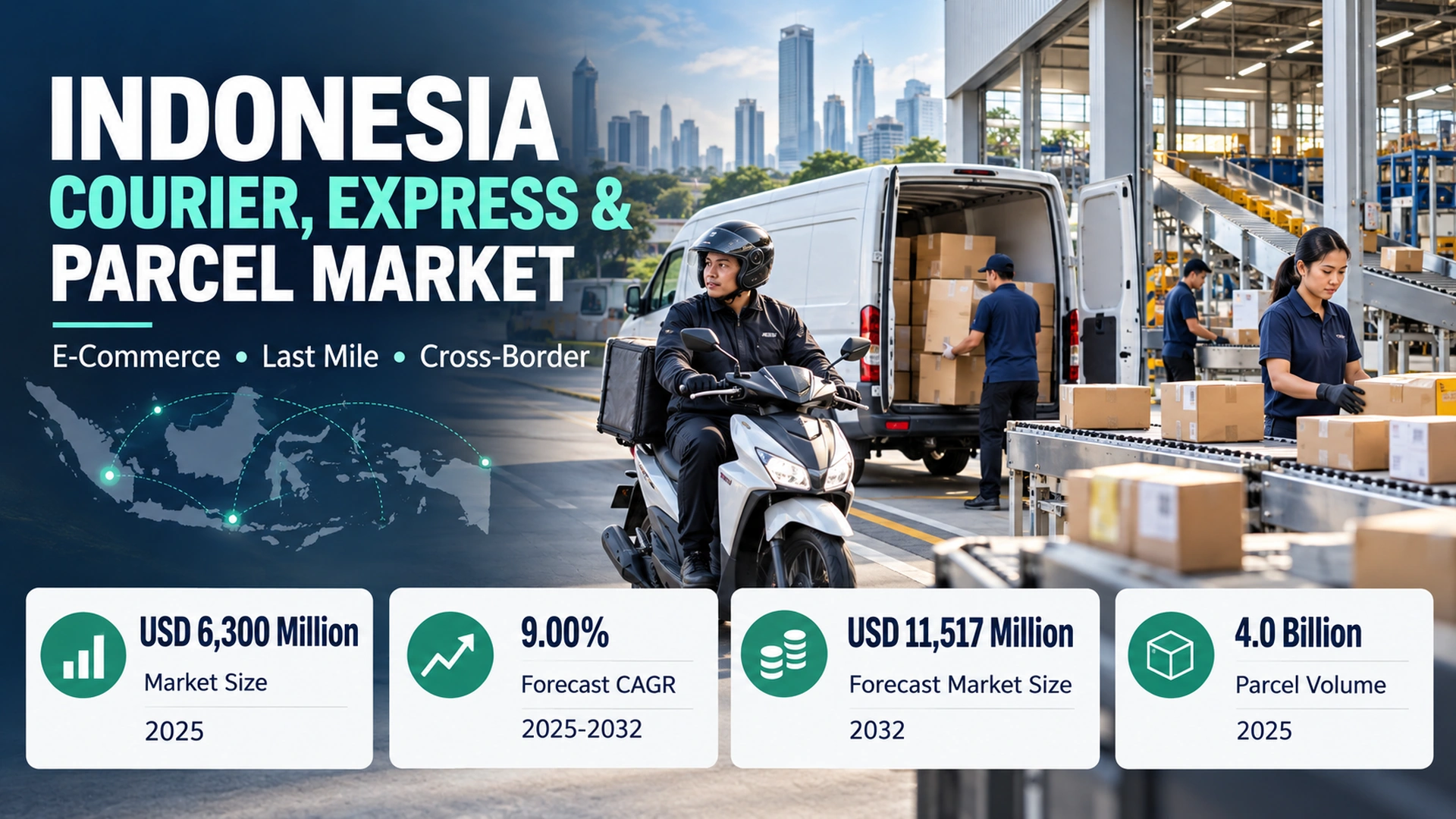
At a Glance
- Market value: USD 6,300 million (2025)
- Forecast value: USD 11,517 million (2032)
- Forecast CAGR: 9.00% (2025-2032)
- Parcel volume: 4.0 bn shipments (2025) growing to 8.57 bn (2032)
- Dominant region: Java
- Dominant segment: Standard Parcel Services
What Is Changing in the Indonesia Courier, Express & Parcel Market?
The market is shifting from pure volume growth to a profitability‑focused model, as automation and dense hub networks become decisive levers for margin resilience. The Indonesia Courier, Express & Parcel Market is projected to expand at a 9.00% CAGR through 2032, but revenue per parcel is expected to fall from USD 1.57 in 2025 to USD 1.34 by 2032, underscoring the need for cost‑efficient scale.
Why Is Automation and Hub Density Important for the Indonesia Courier, Express & Parcel Market?
Impact on Market Demand
E‑commerce‑driven B2C activity already accounts for 58% of market value in 2025, creating a relentless flow of small, time‑sensitive parcels. Automation of sortation facilities enables carriers to handle higher throughput without proportionate labor cost increases, preserving demand‑side growth while containing unit‑cost inflation.
Impact on Competition
Operators with extensive automated sorting lines—exemplified by J&T’s 75 lines in 2025—gain a competitive edge in price‑sensitive standard parcel lanes. The ability to process parcels faster improves SLA performance during peak promotional events, reducing overtime expenses and strengthening merchant relationships.
Impact on Market Growth
While parcel volume is set to double to 8.57 bn shipments by 2032, the implied revenue per parcel declines, making dense hub placement on Java critical. The report notes that roughly 70% of parcel origins are linked to Java, delivering lower line‑haul costs and higher drop density, which directly supports the 9.00% value‑growth trajectory.
What Does the Ken Research Report Reveal About Market Opportunities?
Fastest‑Growing Service Type
Express and time‑definite services are gaining traction in dense urban corridors, especially where e‑commerce merchants demand rapid fulfillment. These premium services command higher yields, offsetting pressure on standard parcel margins.
International Inbound Parcel Segment
International inbound shipments are identified as the fastest‑growing shipment‑flow segment, driven by rising social‑commerce exports and cross‑border trade. Higher service complexity and customs handling translate into superior per‑parcel revenue compared with domestic economy lanes.
Tier‑2 and Outer‑Island Expansion
Policy initiatives aimed at reducing logistics costs are encouraging shared line‑haul and regional hub models. Expanding coverage into Tier‑2 cities and outer islands unlocks new merchant bases, improves route density, and creates a compounding advantage once fixed depots achieve minimum viable throughput.
What Does the Market Shift Mean for Businesses?
Aftermarket and Recurring Revenue Opportunities
Interpretation: The report suggests that operators who bundle returns management, cash‑on‑delivery handling, and technology‑enabled last‑mile services can generate stable recurring revenue streams, mitigating the volatility of pure parcel volume growth.
Market Adoption and Execution Challenges
Interpretation: Price compression remains a structural challenge. Companies like Ninja Van experienced a 3% revenue dip in FY2025 while narrowing pre‑tax losses, highlighting the trade‑off between aggressive pricing and margin preservation.
What Should Indonesia Courier, Express & Parcel Market Participants Watch Next?
- Scaling automated sorting capacity to sustain volume growth while protecting margins.
- Strategic expansion into Tier‑2 and outer‑island routes through hub sharing and digital routing.
- Growth of international inbound parcel flows as cross‑border e‑commerce matures.
- Evolution of premium express and same‑day services in high‑density urban markets.
- Regulatory initiatives aimed at logistics cost reduction and inter‑island connectivity.
Execution Priorities for Market Participants
The Indonesia Courier, Express & Parcel (CEP) market is entering a phase where sheer parcel volume is no longer the sole driver of profitability. While the forecast projects the market value to rise from USD 6,300 million in 2025 to USD 11,517 million by 2032 – a 9.00% compound annual growth rate – the implied revenue per parcel is set to decline from USD 1.57 to USD 1.34 over the same horizon. Interpretation: this compression of per‑parcel earnings forces operators to shift focus toward cost‑efficient scale, automation, and high‑margin service mixes rather than relying on volume alone.
Automation of sortation facilities emerges as a decisive lever. The report notes that J&T operated 75 automated sorting lines by 2025, a benchmark that illustrates how dense, technology‑enabled hubs can absorb higher throughput without proportional labor cost increases. Interpretation: carriers that invest in similar automation can sustain service level agreements during peak e‑commerce events, reduce overtime expenses, and protect margins despite price competition. Moreover, dense hub placement on Java – where roughly 70% of parcel origins are linked – yields lower line‑haul costs and higher drop density, reinforcing the 9.00% value‑growth trajectory. Operators should therefore prioritize expanding automated hubs in Java’s high‑density corridors while exploring hub‑sharing models for Tier‑2 and outer‑island routes.
Service‑type diversification is another priority. Standard parcel services remain the backbone, accounting for the dominant segment share, yet the fastest‑growing segment is express and time‑definite services, especially in dense urban corridors. Interpretation: premium express and same‑day offerings command higher yields, offsetting the downward pressure on standard parcel margins. Companies that can bundle these premium lanes with value‑added solutions – such as cash‑on‑delivery handling, returns management, and technology‑enabled last‑mile delivery – stand to generate recurring revenue streams that smooth volatility inherent in pure volume growth.
Cross‑border and international inbound parcels represent a high‑margin growth frontier. The market data identifies international inbound shipments as the fastest‑growing shipment‑flow segment, driven by rising social‑commerce exports and broader e‑commerce trade. Interpretation: operators that develop capabilities for customs clearance, international tracking, and premium handling can capture superior per‑parcel revenue compared with domestic economy lanes. Aligning network design to support these flows – for example, by locating dedicated international processing hubs near major airports – will be critical as Indonesia’s trade integration deepens.
Finally, regulatory and infrastructure initiatives aimed at reducing logistics costs and improving inter‑island connectivity will shape execution roadmaps. Policy measures that encourage shared line‑haul, multimodal transport, and digital routing can lower fixed‑cost barriers for Tier‑2 and outer‑island expansion. Interpretation: market participants should monitor government programs, engage in public‑private partnerships, and adopt flexible routing platforms to capitalize on emerging connectivity improvements while maintaining route density and hub utilization.
Additional Execution Considerations
The 2025 base shows a market value of USD 6,300 million and a parcel volume of 4.0 billion, with Java generating roughly 70% of origins. This concentration enables lower line‑haul costs and higher drop density, a structural advantage as the market pursues a 9.00% CAGR to USD 11,517 million by 2032. Interpretation: operators that deepen hub density on Java can sustain the projected value growth while mitigating unit‑price erosion.
Automation is highlighted by J&T’s 75 automated sorting lines in 2025, illustrating how technology‑enabled hubs absorb higher throughput without proportional labor increases. The implied revenue per parcel falls from USD 1.57 in 2025 to USD 1.34 in 2032, reinforcing the need for cost‑efficient scale. Interpretation: investment in automated sortation directly supports margin resilience amid price compression.
Premium services are gaining traction; express and time‑definite offerings are the fastest‑growing segment in dense urban corridors, while international inbound parcels are identified as the fastest‑growing shipment‑flow. These lanes command higher yields that can offset pressure on standard parcel margins. Interpretation: diversifying into high‑margin express and cross‑border services is essential for earnings quality.
Tier‑2 and outer‑island expansion, driven by policy initiatives to reduce logistics costs, presents an opportunity for hub‑sharing models and digital routing. Interpretation: coordinated network design across islands can unlock new merchant bases while preserving route density.
Conclusion: Indonesia Courier, Express & Parcel Market Outlook
The Indonesia Courier, Express & Parcel Market is set to more than double its value by 2032, driven by robust e‑commerce demand and a 9.00% CAGR. Success will hinge on operators’ ability to leverage automation, densify hub networks on Java, and capture higher‑margin premium and cross‑border segments while navigating price‑compression pressures.