
At a Glance
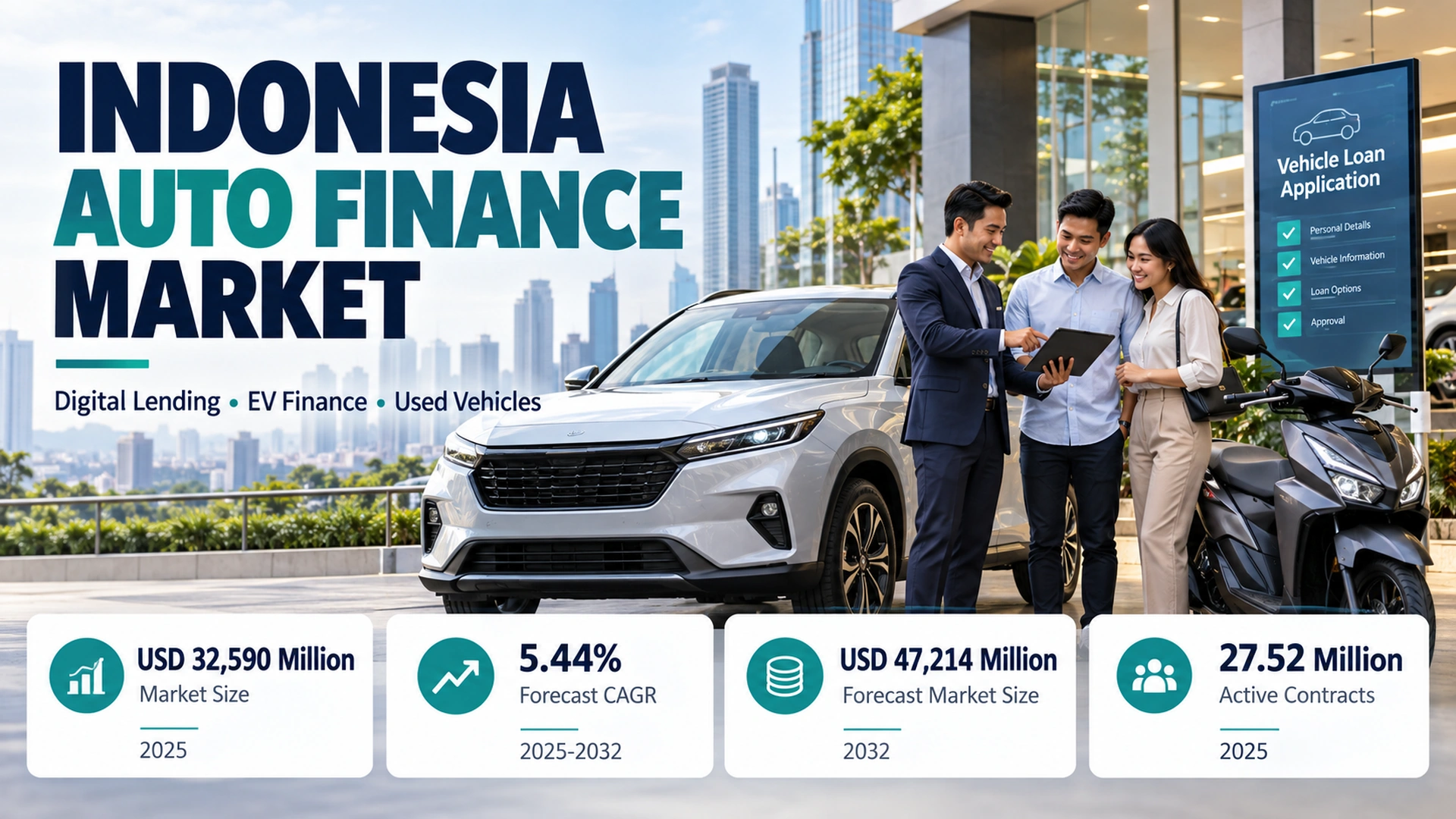
- Market value USD 32,590 million in 2025
- Projected to reach USD 47,214 million by 2032 (5.44% CAGR)
- Active contracts: 27.52 million (2025) growing to 30.84 million (2032)
- Average balance per contract rises from USD 1,184 to USD 1,531
- Digital Direct distribution channel is the fastest‑growing segment
- Java remains the dominant region for credit demand
What Is Changing in the Indonesia Auto Finance Market?
The market’s value trajectory is now being driven less by sheer contract volume and more by premiumization of ticket sizes, as used‑vehicle financing, electric‑vehicle (EV) credit and 0% down‑payment flexibility offset a 7.2% decline in new‑car sales in 2025. Indonesia Auto Finance Market analysts note that the average outstanding balance per contract is set to climb from about USD 1,184 in 2025 to USD 1,531 by 2032, delivering the bulk of the projected USD 14.6 billion value uplift.
Why Is Premium Ticket Growth Important for the Indonesia Auto Finance Market?
Impact on Market Demand
Demand for higher‑ticket products is expanding as consumers shift toward used vehicles and EVs, both of which command larger financing amounts. The used‑car financing pool was valued at USD 8,150 million in 2025, while the EV book grew to USD 1.26 billion by January 2026, reflecting a 27% balance increase over the prior year. These segments broaden the addressable borrower base beyond new‑car purchasers, especially in the Java corridor where dealership density and formal employment are highest.
Impact on Competition
Lenders that can combine lower‑cost funding with sophisticated risk analytics are poised to capture the premium share of the market. Multifinance firms with strong dealer‑API integrations and digital‑direct channels are outpacing traditional bank‑direct KKB, which weakened after mid‑2025 (5.5% YoY growth in June 2025, then a 19.7% YoY contraction for BCA’s KKB portfolio in Q1‑2026). This competitive shift underscores the strategic advantage of digital acquisition and rapid pre‑approval processes.
Impact on Market Growth
Because contract volume is projected to rise modestly—from 27.52 million to 30.84 million—value growth hinges on ticket‑size expansion. The forecasted average balance per contract increase of roughly USD 347 (29% over the period) translates into a value CAGR of 5.44%, outpacing the contract‑volume CAGR of about 3.5%. OJK’s 2026 guidance of 6‑8% receivables growth for the broader financing‑company sector further supports this premium‑driven outlook.
What Does the Ken Research Report Reveal About Market Opportunities?
Fastest‑Growing Distribution Channel: Digital Direct
Digital Direct is identified as the fastest‑growing distribution channel, leveraging mobile applications, dealer APIs and marketplace lead generation to reduce acquisition friction. Lenders that invest in end‑to‑end digital journeys can achieve faster decision speeds and lower cost‑to‑serve, a decisive edge in a market where branch density is less critical.
Used‑Vehicle Financing as a Value Lever
Used‑vehicle financing remains resilient despite a 3.64% contraction in new‑vehicle financing (October 2025). The USD 8,150 million used‑car financing reference market in 2025 offers a sizable pool for lenders to monetize through interest, inspection fees, insurance and refinancing services. Robust appraisal and remarketing capabilities are essential to capture this opportunity.
EV Financing – A Higher‑Ticket Specialty Segment
EV financing surged from approximately USD 0.99 billion at the end of 2024 to USD 1.26 billion by January 2026, a 27% balance increase. The higher ticket sizes of EV loans accelerate receivable growth faster than contract counts, but require battery‑residual analytics and tailored LTV policies (up to 100% for qualifying portfolios). OEM partnerships and government tax incentives further enhance the attractiveness of this segment.
What Does the Market Shift Mean for Businesses?
Aftermarket and Recurring Revenue Opportunities
Interpretation: The report suggests that lenders can augment recurring revenue by bundling financing with ancillary services such as inspection, documentation, insurance and vehicle‑backed refinancing. The used‑vehicle and EV segments, in particular, generate cross‑sell potential that extends beyond interest income.
Market Adoption and Execution Challenges
Interpretation: While 0% down‑payment eligibility expands the addressable market, it also raises sensitivity to borrower selection. Gross NPF stood at 2.51% in December 2025, with net NPF at 0.77%, indicating that credit quality remains a gating factor. Lenders must balance aggressive origination with stringent risk controls to avoid eroding profitability.
What Should Indonesia Auto Finance Market Participants Watch Next?
- Regulatory evolution of OJK’s 0% down‑payment rule and NPF thresholds
- Scaling of digital‑direct platforms and dealer‑API integrations
- Growth trajectory of EV adoption and related subsidy programs
- Performance of used‑vehicle financing amid new‑car sales volatility
- Bank‑direct KKB recovery or further contraction
Execution Priorities for Market Participants
The Indonesia Auto Finance Market is projected to rise from USD 32,590 million in 2025 to USD 47,214 million by 2032, a 5.44% CAGR. While active contracts increase modestly from 27.52 million to 30.84 million, the average balance per contract climbs from USD 1,184 to USD 1,531. This premium‑ticket growth, driven by used‑vehicle and electric‑vehicle (EV) financing, now supplies the bulk of value creation. Interpretation: Lenders that focus on higher‑ticket products will capture disproportionate share of the projected USD 14.6 billion value uplift, even if contract volume expands slowly.
Geographically, Java remains the dominant region, accounting for roughly 41 million registered vehicles in 2023. The concentration of population, dealership density, and formal employment makes the Java corridor the primary arena for dealer‑embedded finance and digital‑direct acquisition. Interpretation: Investment in dealer APIs, mobile onboarding, and localized collections infrastructure in Greater Jakarta and West Java will yield the highest return on acquisition spend.
Digital Direct is identified as the fastest‑growing distribution channel. Mobile applications, marketplace lead generation, and pre‑approved credit limits reduce friction and lower cost‑to‑serve compared with traditional branch sales. Interpretation: Institutions that accelerate end‑to‑end digital journeys—integrating credit scoring, e‑signatures, and instant disbursement—will outpace bank‑direct KKB, which weakened after mid‑2025.
Used‑vehicle financing, valued at USD 8,150 million in 2025, and EV credit, reaching USD 1.26 billion by January 2026, are expanding faster than new‑car financing, which fell 7.2% in 2025. Both segments command larger ticket sizes and require robust appraisal, remarketing, and battery‑residual analytics. Interpretation: Lenders should develop specialized risk models and ancillary revenue streams (inspection fees, insurance, refinancing) to monetize these higher‑ticket portfolios while maintaining gross NPF at 2.51% and net NPF at 0.77%.
Regulatory guidance from OJK anticipates 6‑8% receivables growth for financing companies in 2026, but retains strict NPF thresholds. Interpretation: Capital‑efficient institutions with access to low‑cost funding and sophisticated credit analytics will be best positioned to meet growth targets without breaching risk limits.
Conclusion: Indonesia Auto Finance Market Outlook
The Indonesia Auto Finance Market is set to grow to USD 47,214 million by 2032, propelled by premium ticket growth in used‑vehicle and EV financing and accelerated digital‑direct distribution. While contract volume expands modestly, lenders that master risk analytics, digital acquisition and ancillary service monetization will capture the majority of value creation. OJK’s policy backdrop and Java’s concentration of demand will continue to shape strategic priorities for investors and operators alike.